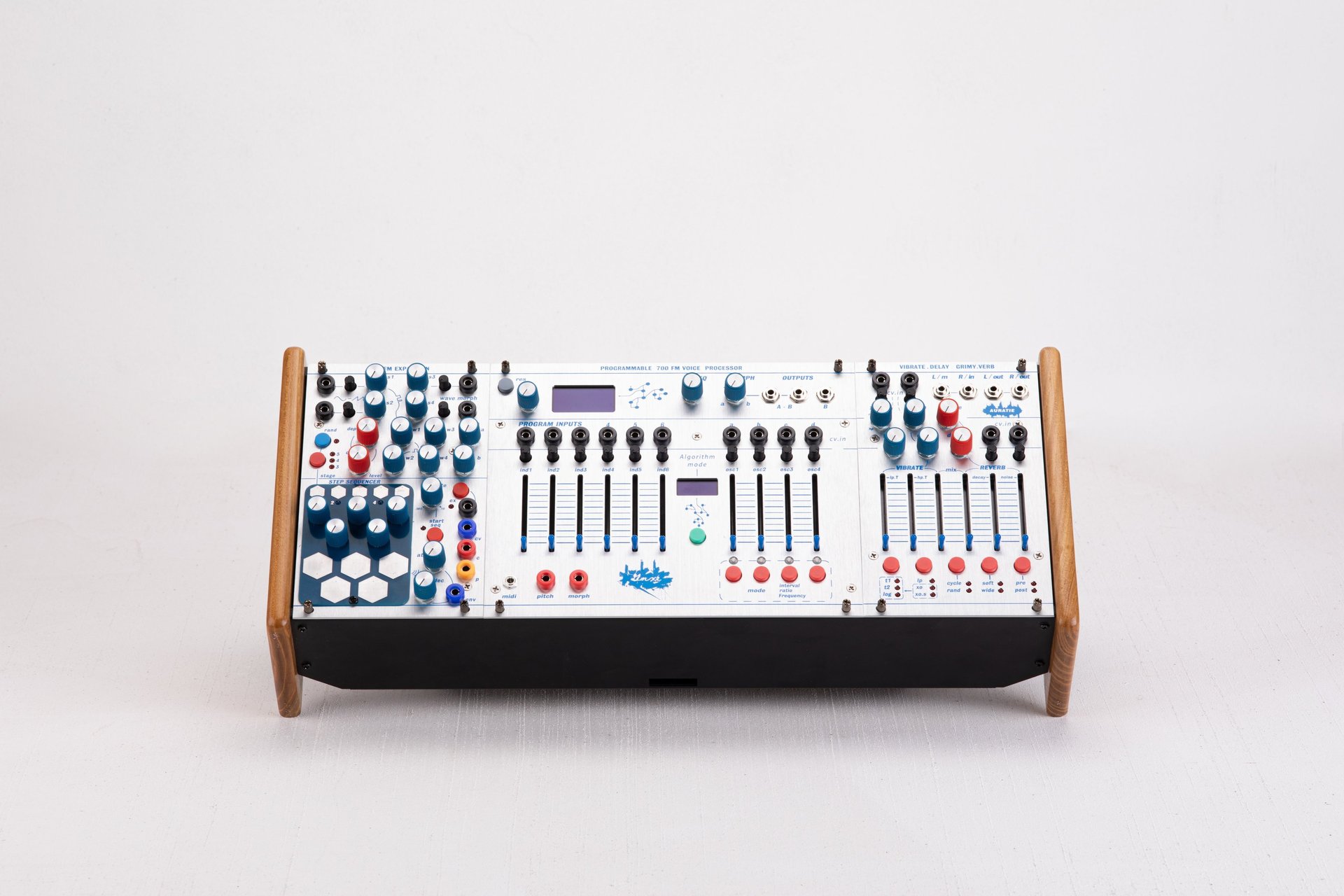
700 Poly v1.05 Official Release
4-voice polyphonic architecture with full MIDI CC support.
Boots into Mono mode by default.
Update Changelog
Added MIDI channel selection in the settings menu.
Added velocity blend adjustment for Voice Mode.
Optimized algorithms for oscillators, filters and waveshaping; improved CPU efficiency under high-load and fast-response conditions.
Refined smooth MIDI CC control, with major improvements to filter parameters.
Fixed an issue where the release stage of the ADSR envelope would occasionally drop out during playback.
Adjusted the voice priority logic for 4-voice polyphony: previously the first voice would be retriggered when exceeding four notes; now the last played note is retriggered instead.
Enhanced the Dirty Mod function for better compatibility with polyphonic mode.
Enabled all MIDI CC mapping functions.
Fixed an issue where pitch knobs and faders were unresponsive in Mono mode.
Resolved an oscillator crash bug caused by feedback algorithms processing out-of-range frequencies.
Further improved oscillator sound quality and reduced CPU resource usage.
Added support for MIDI keyboard Hold and Pitch Bend functions.
Fixed the issue of persistent high-frequency low-level noise introduced in firmware version 2.1
Improved Parameter smoothing for the expansion module.
Fixed an issue in Config 10 where one graphical connection line was
missing
Fixed an issue where button operation LED modes and config display
graphics would sometimes not match the actual system state
• UI Interface Redesign:
Optimized oscilloscope display for better visualization.
• Added Filter Functionality and Interface Editing:
• Added filter modules at the end of both Output A and Output B.
Through the menu, the Map function can be used to assign specific knobs to control the
filter cutoff frequency.
Channel A:
Can replace the Morph knob or Ind3 knob.
Channel B:
Can replace the Morph knob or Ind3 knob.
In "no" mode: Adjust the cutoff frequency directly through the menu.
• Added Calibration Page:
Allows fine-tuning of 1.2 V/oct (useful for keyboards with unstable voltage output or other
calibration issues).
• Wave Shape Module Optimization:
Improved harmonic characteristics
Eliminated offset issues
• MIDI Comprehensive Optimization:
Stable note input via MIDI is now possible
**Important Notice: Due to hardware design limitations, v1 versions of 700 Voice may
experience conflicts when connected to expansion modules. For stable MIDI
functionality, please disconnect expansion modules and connect 700 Voice directly to the
MIDI interface.
• Performance and Control Optimization:
Reduced CPU usage by 12%
Improved overall operational efficiency
• Firmware Upgrade Instructions
For firmware updates, please refer to the 700 Voice update tutorial. The update method
remains unchanged.
Fixed an issue where the Envelope function would
occasionally fail to operate during startup initialization.
1. ARP Mode Added to the RAND Mode Selection
A new ARP mode has been added to the RAND mode options.
When switching to ARP mode, the blue LED will display a breathing pulse to indicate that
ARP mode is active.
In ARP mode, there are two editing states:
(1) When SEQ is (OFF)
The touch keyboard is used to edit and trigger arpeggios.
Touching the keys will trigger the arpeggio.
Releasing your fingers will stop the arpeggio.
The number and order of touched keys determine the arpeggio pattern and sequence.
(2) When SEQ is (ON)
Touch input is no longer used for arpeggios.
Instead, touch controls the starting position of the sequence stages.
For example, you can select 4-step or 3-step operation, allowing the sequence to shift
from the original 1-2-3-4 loop to patterns such as:
2-3-4-5
3-4-5-1
The RAND mode cycle order is now:
Normal → Random → Seed → ARP
(4 modes in total)
2. Stability Fix
14 hours).
Fixed a system crash issue that could occur after long continuous operation (around 12–
3. Envelope Engine Reworked
The envelope system has been rebuilt, providing:
Faster response
More precise parameter control
Better performance and feedback in keyboard mode
4. Instant Boot
The startup delay has been removed.
The system now boots instantly when powered on.
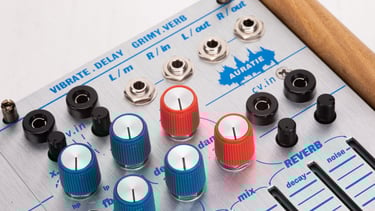
LP/XO Section Reimagined – 3 Switchable ModesThe LP (XO) section now supports three operational modes, selected via a mode switch:
LP Mode:In LP mode, the T1, T2, and LOG buttons each correspond to one of the three delay algorithms. The Xover knob controls a newly added classic ladder-style filter, which is placed after the delay.
XO Mode:Activates pitch-shifting placement before the reverb. The T1, T2, and LOG buttons still reference the original delay types, but with additional pitch-shift variations. The Xover knob now adjusts pitch-shift interval (in semitones). Lowpass behavior is fixed and interacts with the delay mod parameter.
XOS Mode:Moves the pitch shift after the reverb and integrates it into the reverb feedback path, creating a shimmering, evolving texture.
T2 Fader Renamed to Delay ModThe T2 fader is now labeled Delay Mod, and controls multiple parameters in a linked fashion—including tape-style depth effects, saturation, and LFO modulation depth.
Rate and Depth as a Dedicated Pitch Shift SectionRate continues to control LFO frequency, while Depth now adjusts the intensity of the pitch shift effect, forming a distinct pitch modulation zone.
LFO Modes UpdatedThe Cycle mode retains its original behavior. In Random mode, a sample-and-hold approach is used to create fluctuating random voltages per cycle, resulting in more organic modulation patterns.
Soft/Wide Reverb Modes Enhanced
Soft Mode: Retains its smooth character but now features extended decay range, allowing for tight, intimate spaces or expansive ambient tails.
Wide Mode: Introduces additional feedback and spatial parameters that scale with decay time. Be cautious—this mode can create infinite reverberant textures.
Noise Behavior RefinedAt low levels, the noise parameter now subtly introduces harmonic distortion and bit crush textures. As the knob increases, broader layers of ambient noise are introduced, expanding the sonic landscape.
Pre/Post Behavior EnhancedThe Pre/Post switch still determines the order between delay and reverb. However, pitch shift is now considered part of the reverb chain. This means the delay is either placed at the very beginning or the end of the entire effects structure.
Regarding Mix1 and Mix2, the fader logic includes a threshold: within the first 65% of the range, the dry signal remains unaffected, creating a send/return-like effect. Beyond that point, the dry signal gradually decreases until it reaches fully wet.